Wednesday, 13 March 2013

Reflection 2 : Electronic Portfolio


Assalamualaikum w.b.t

During lecture on 19th February 2013, we discussed about “Electronic Portfolio”, or mostly known as E-Portfolio. Hurm, what is E-Portfolio? To those who wonder, E-Portfolio is a technology based collection of students’ work over a period of time. It has been used by the lecturers, or in certain schools, teachers, to evaluate their students. But why E-Portfolio? Well, advances in research and technologies have invented the innovative and creative way for the teachers and parents to keep track of their students and children’s activities. It is more organized, and the progress can be charted easily.

In addition, compared to the printed portfolio, E-Portfolio is less bulky, and taking less space to keep. Besides, E-Portfolio can be enhanced by sounds, music, pictures, graphics and even videos!!! How appealing is that? Isn’t that great? It lets and encourages the students to play and explore their creativity in creating, collecting, organizing and editing their group E-Portfolio. There are a lot more advantages of E-Portfolio, but in a simple word, E-Portfolio helps both the students and their instructors.

Until then,
Assalamualaikum.


Task 1 : Questions on Varieties of English

Assalamualaikum w.b.t

This week we were given few questions on our chosen Linguistics area, Varieties of English. Here are the questions and what we came out as the answers after our discussion.

1.      Did the course incorporate the use of computer in the teaching and learning?
2.      Are the computer-based activities related to any of the THREE stages of CALL?
3.      What are the important concepts in the THREE stages related to the activities?

Yes, indeed computer was used by both lecturer and students in the learning process of this subject. But we do not fully rely on computer as we learn because the subject depends on the experiences of the lecturer on the knowledge of languages around the world. Role on the student here is to understand the lesson with various introductions to Englishes across the globe as they learn different speaking styles and diverse IPA sound or spelling.

Behaviorist CALL includes in this learning process as questions are rarely asked in the class and slides are basically shown by the lecturer throughout the lesson. Communicative CALL is not quite included and there was a bit of Integrative CALL because students used slides in their presentations too. Thus, students essentially use computer to look for different styles of language from all over the world as well as looking for references for different kinds of pronunciation.

Reflection 1 : History of CALL


Assalamualaikum w.b.t.

On the first week, we were introduced to the history of Computer Application in Language Learning (CALL). Here goes the summary of the lesson.

Computer Application in Language Learning (CALL) begun in the year 1960s, around the time computer was created. CALL exists to assist language learners in their learning process.  Ever since its existence, CALL has undergone 3 major stages of educational theoretical cycle:

1.      Behaviorist CALL
2.      Communicative CALL
3.      Integrative CALL

The lesson is summarized in the table,

Behaviourist
Communicative
Integrative
  • Behaviorist learning model
  • Cognitive approach
  • Integrative approach
  • Computer as mechanical tutor
  • Computer as pupil
  • Computer as a vehicle/ tool
  • Language as a system of structurally related elements for the coding of meaning
  • Encourages discovery learning
Focus: Use of forms
  • Task-based, content-based & project-based methods
  • Structural view- Language learning as a form of habit
  • Teacher usually to be distant and students work on their own
  • Authentic use of language
  • e.g: Learning the grammar of a language
  • e.g: Doing online exercises on the computer
  • e.g: Learners question and have a discussion with native speakers or classmates via computer


Profile + Group Photo


GROUP PROFILE

Julaiha, Aimi, and Asma'

Group Members:

1. Name             : Julaiha Shazmira binti Malizan
    Year of Study: Year 4
    Email              : julaiha90@yahoo.com

2. Name             : Aimi Farhein binti Ramli
    Year of Study: Year 4
    Email              : aimyramli@gmail.com

3. Name             : Asma' binti Ab.Razak
    Year of Study: Year 4
    Email              : asma.abrazak@gmail.com

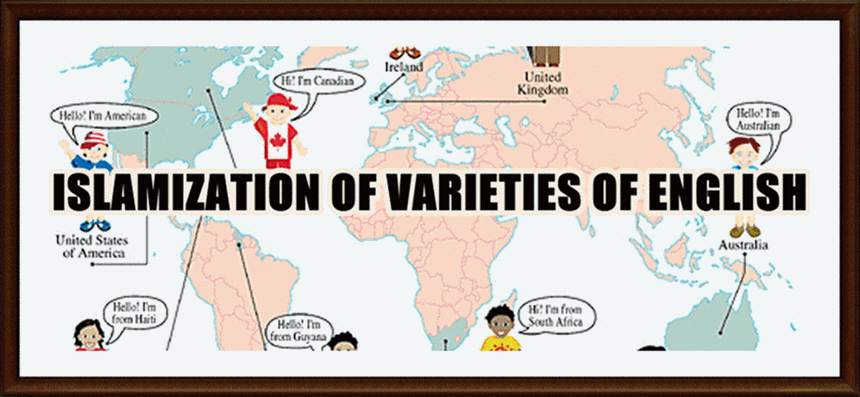
Islamization of Varieties of English


Assalamualaikum w.b.t.

 In our attempt to Islamize one of the linguistics’ subjects, we chose Varieties of English. We bet that people must be wondering, “why Varieties of English?” In certain part of our society, many misunderstood about the status of English language itself. They said that learning English is not as important as learning Arabic. Some said that one tends to be influenced by the negative cultures of the Westerns once he learned English language. No doubt about the status of Arabic is very important in a Muslim’s life. However, Muslims are encouraged to learn other languages mainly the languages that are spoken by many, mostly the languages that can be understood and are used by many people around the world. Why? Because being a Muslim means that we are the Daie. We have responsibilities to propagate Islam around the world. And to do this, we need to communicate to them using the medium they can understand. We are the caliphs of Allah.

Lovely friends,

As Allah has said in the verse 13 surah al-Hujurat, He created us in many people and tribes so that we may know each other. He created many languages so that we may learn and use it wisely to propagate Islam. As an example, look at Imam Suhaib Webb, Yasmin Mogahed and many distinguished figures that used English to explain the beauty of Islam to people.

Our dear friends,
Just because some of the cultures in where English is spoken the most are not very pleasant cultures, it doesn’t mean that English itself is a bad language. Everything is based on our niyyah (intention). If we were to have a bad purpose or intention in doing something, then it is a bad act. Otherwise, if what we are going to do can benefit the Ummah, no matter how challenging it is, stays put and move forward. Do not feeling down just because people said we are just an English major, we will never give a great contribution to the society and such and such. Remember one thing, if language can bring us closer to Allah, then what is wrong with learning it. No matter how difficult and tough the journey is, surely He’ll make it easy for us.

Lastly,
Insya Allah, this is the beginning of our contribution to Ummah. To encourage the Ummah learning English with Islamic values, and hence they will understand our purposes and efforts in learning English language. May this small step be counted for all of us.

Until then, Assalamualaikum.